Guide — 2026
A Complete Guide to Armenia (Jp)
Travel, history, alphabet and everyday phrases for a country with almost no Japanese-language material online.
I make guides and dictionaries — for Armenia, for Tajik, for Cabo Verde — the kind of thing that used to be a book, built now as a website you can search and an app you can carry. Each one starts because I wanted it to exist and found that it didn’t.
Travel, history, alphabet and everyday phrases for a country with almost no Japanese-language material online.
Grammar, script and vocabulary for a Persian language written in Cyrillic — assembled from scattered sources into one place.

Islands, music and Kriolu — a fan’s record of an archipelago, written for people arriving with no prior reference.
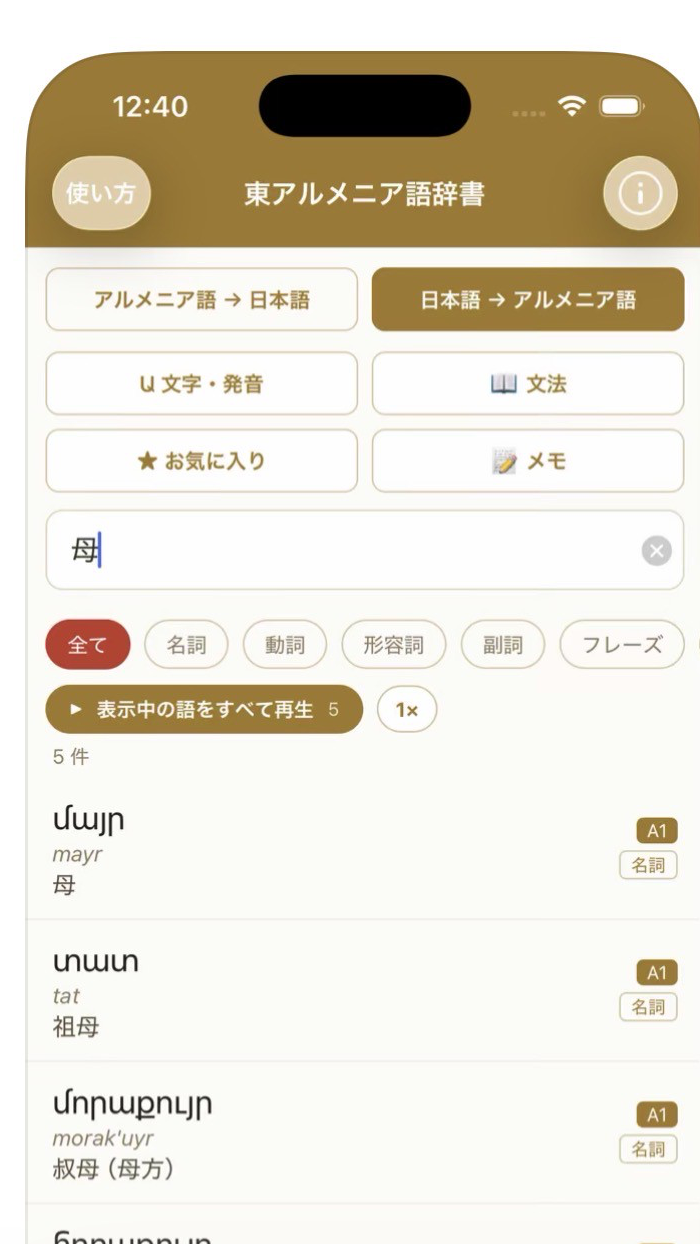
The first dictionary of its kind for Japanese speakers: Eastern Armenian headwords, readings and senses, searchable offline in the Armenian script or in kana, with audio recorded by native speakers. Built because the paper equivalent does not exist. Released on 12 August 2026, it spent its first five days at No. 1 in the paid Dictionaries category of the Japanese App Store.
A guide is finished when a stranger can use it without asking me anything.
Everything here follows the same method. Read the sources — often in three languages, often contradicting each other. Reduce them to something a beginner can hold. Ship it plainly: fast pages, real typography, no accounts, no interstitials, nothing between a reader and the thing they came for.
The sites and the apps are made by one person, which is the constraint and also the point: scope stays small, the material stays accurate, and corrections ship the same day.
Yeongho Lee
Linearize is my independent practice for research-led reference projects — writing, structuring and building each one end to end, from the source material through to the front-end and the App Store listing.
Linearize the path to knowledge.
To linearize, in mathematics and engineering, is to bring something nonlinear into a form that can be analysed and worked with. Knowledge behaves the same way. Learning a language like Armenian or Tajik means branching endlessly — find the reference grammar, decode the script, hunt for trustworthy audio, cross-check a dictionary, then check how the word is actually used.
Linearize draws one road through that thicket: start here, go in order, arrive. Not by thinning the subject out — the complexity stays, and so does the rigour — but by making the route to it plain. Complex knowledge, a clearer path; the field can be language, culture, or anything else specialists reach easily and everyone else does not.
Write to me here.
Commissions, collaborations, corrections to a guide, or a note when a new project ships — all welcome. Messages reach me directly; I answer in English or Japanese, usually within a few days.
Armenia is a country most Japanese travellers reach with almost nothing to read first. The guide fills that gap: where to go and when, what the alphabet is doing, how the church calendar shapes a town’s year, and enough of the language to be polite on arrival.
It is organised as a reference rather than a blog — chapters that stay current, cross-linked to phrases and place names in Armenian script so a reader can point at a page and be understood.
Tajik is Persian written in Cyrillic, and that single fact strands most learners: Persian textbooks teach a script it doesn’t use, Russian ones assume the grammar. This guide teaches it on its own terms, from the letters up.
Every rule is paired with example sentences and, where it helps, the Persian cognate — so a reader who already knows one of the two languages can cross over instead of starting again.
Ten islands, one creole, and a musical tradition better known than the country itself. Cabo Verde Fans is the reference I wanted before my first trip: island by island, with the language and the music treated as seriously as the beaches.
It is written for readers arriving with no prior reference at all — and kept in step with the ferries, the festivals and the records worth hearing.
A dictionary between Eastern Armenian and Japanese, offline, in your pocket. Search from either side — Armenian script, Latin transliteration or kana — and get headwords with readings, senses and usage notes rather than a single gloss, each spoken aloud by a native speaker of Eastern Armenian.
The entries come out of the same research as the Armenia guide, and the two are meant to be used together: read the chapter, carry the dictionary. Released on 12 August 2026, it spent its first five days at No. 1 in the paid Dictionaries category of the Japanese App Store.
View on the App Store